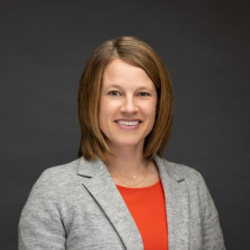
Congratulations to Kari Dietrich for 10 years of service supporting medical education and training at UW Pediatrics and Seattle Children’s! In a role that often works behind the scenes, Kari helps ensure medical students, residents, and fellows have the structure and assistance they need to thrive, strengthening the learning environment and ultimately the care our patients receive. When Kari reflects on reaching a decade with our team, one feeling rises to the top: surprise.
Finding the Right Fit
Kari’s path into medical education was not something she carefully mapped out.
“I sort of fell into medical education,” she recalled about her early role at Harborview helping a new emergency medicine residency. “I knew nothing at the time, but it fit my degrees.”
With a background in business and higher education in administration, she quickly established critical processes that supported both the operational and academic sides of training programs, simplifying workflows and improving program efficiency.
When the UW Pediatrics role opened, she almost didn’t apply, but a mentor encouraged her. She got the job.
What Keeps Her Here
Over the years, Kari said two things have kept her at UW Pediatrics. “I’ve felt both challenged in the work and completely supported,” she reflected. “It feels amazing to have a job that has a real sense of purpose, to help train future physicians.”
The second part is the community. “The people I work with are the kindest, most talented, and compassionate group I could ask to work with,” she said. “I feel really fortunate to have a job that has both of those components.”
That combination of purpose and people has made the work meaningful, even as the landscape of medical education has changed dramatically over the past decade.
Growth, Change, and Resilience
In 10 years, Kari has observed significant shifts in medical training. Early on, she saw the first wave of UW trainees unionizing, a moment that changed expectations around trainee well-being, compliance, and accreditation.
“It was a big shift in medicine, and for the better,” she said. “There’s been a real effort to make training better for trainees and physicians, and with that come big system changes.” At the same time, UW Pediatrics and Seattle Children’s have grown rapidly, adding subspecialties, expanding training programs, and navigating broader financial pressures and federal policy changes.
“There’s no way we could operate now the way we did 10 years ago and still meet the mission,” she said. “The administrative side has grown tremendously, and I have developed new frameworks to meet evolving needs for structure and formality. It’s been really impressive to watch how the work has evolved to support that growth.”
Ask Kari what a typical day looks like, and she smiles. “There has never been a typical day,” she said. “It truly changes month to month, year to year. But at the core, a lot of it is still problem-solving. The focus and the nature of the problems just change over time.”
She describes her role simply as supporting medical students, residents, and fellows who complete any part of their training. Her work spans program oversight, compliance, finance, and operations, all of which are essential to keeping training programs running smoothly.
“Most people are surprised to learn that we have over 1,600 individuals training here,” she said. “The sheer number of people our faculty train across all specialties, not just pediatrics, is really impressive.”
A Perspective that Changed Everything
One experience stands out in shaping how she sees her work today. Just before returning from her second maternity leave, Kari’s family spent eight days in the NICU during the RSV and COVID season. “It was my first time seeing what fellows and residents experience,” she said. “It’s like a city inside the hospital.”
Watching trainees and physicians care for children through long shifts and holidays left a lasting impression. “These people sacrifice time with their families. It motivates me to support their work,” she said.
Looking Ahead
As she looks to the future, Kari is energized by watching trainees grow into leaders.
“In 10 years, I’ve seen trainees become faculty and then leaders here,” she said. “Watching people grow into what they want to do and lead others has been really rewarding, and I’m excited to see more of that.”
She is also curious about how emerging tools, especially artificial intelligence, may reshape both education and administrative work. “I think AI is going to transform the education and teaching landscape, but also the administrative side,” she said. “The hopeful part is that it creates capacity to build community and resilience in work that can be really hard.”
For someone new to UW Pediatrics, her advice is simple and heartfelt.
“Attend the events when you’re able to. We have such a wonderful community, and getting to know the people really makes the work rewarding.”
After 10 years, Kari’s work may often happen quietly behind the scenes, but its impact is anything but small. Through growth, change, and challenge, she has helped build the structure that supports more than 1,600 learners and the future of pediatric care in our community.
Kari’s first 10 years made a profound difference, and UW Pediatrics looks forward with anticipation and gratitude to all she will help build in the coming years.